



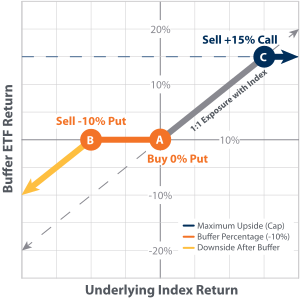
If the reference asset is down 20%, the ETF would be down just 10% because the first 10% of loss is protected by the buffer.

Target Outcome UCITS ETFs
How do Target Outcome UCITS ETFs work?
Target Outcome UCITS ETFs are actively managed ETFs that seek to provide targeted exposure to an underlying reference asset. The ETF is set up to provide a predetermined investment outcome, equipped with a feature to remove some of the uncertainty associated with investing.
The Target Outcome Buffer Series UCITS ETFs are designed to help equity investors maintain a level of protection in down markets, by seeking to provide a defined downside buffer, over a specified Target Outcome Period. At the same time the strategy looks to take advantage of growth opportunities in up markets up to a predetermined cap. The cap and buffer are reset at the end of each Target Outcome Period. However, the funds may be held indefinitely, providing investors a potential buy and hold investment opportunity.
How does it fit in the portfolio?
First Trust Target Outcome Buffer ETFs are designed to help investors maintain a limited buffer in down markets, while taking advantage of growth opportunities (up to a cap) in up markets. They can potentially fit in two places in an investor’s portfolio:
Low Risk/Hedged Equity
The ETFs may deliver benefits of upside from equities with reduced downside risk, allowing investors to stay invested.
Alternatives
Risk/return characteristics provide a limited downside buffer while capping some upside potential, similar to alternative investments. ETFs may be used as potentially cost-competitive replacements to hedge funds.
Objective at the end of a Target Outcome period
The examples assume ETF shares are purchased on the first day of the Target Outcome Period and held until the end of the period.
10% Buffer

Reference Asset
Buffered Range
Target Outcome ETF
Performance Cap
Negative Scenario
BUFFER EXCEEDED
Negative Scenario
Negative Scenario
WITHIN BUFFER RANGE
Negative Scenario
Positive Scenario
WITHIN CAP
Positive Scenario
Positive Scenario
CAP EXCEEDED
Positive Scenario
15% Moderate Buffer

Reference Asset
Buffered Range
Target Outcome ETF
Performance Cap
Negative Scenario
BUFFER EXCEEDED
Negative Scenario
Negative Scenario
WITHIN BUFFER EXCEEDED
Negative Scenario
Positive Scenario
WITHIN CAP
Positive Scenario
Positive Scenario
CAP EXCEEDED
Positive Scenario
Max Buffer
How does a Max Buffer work?
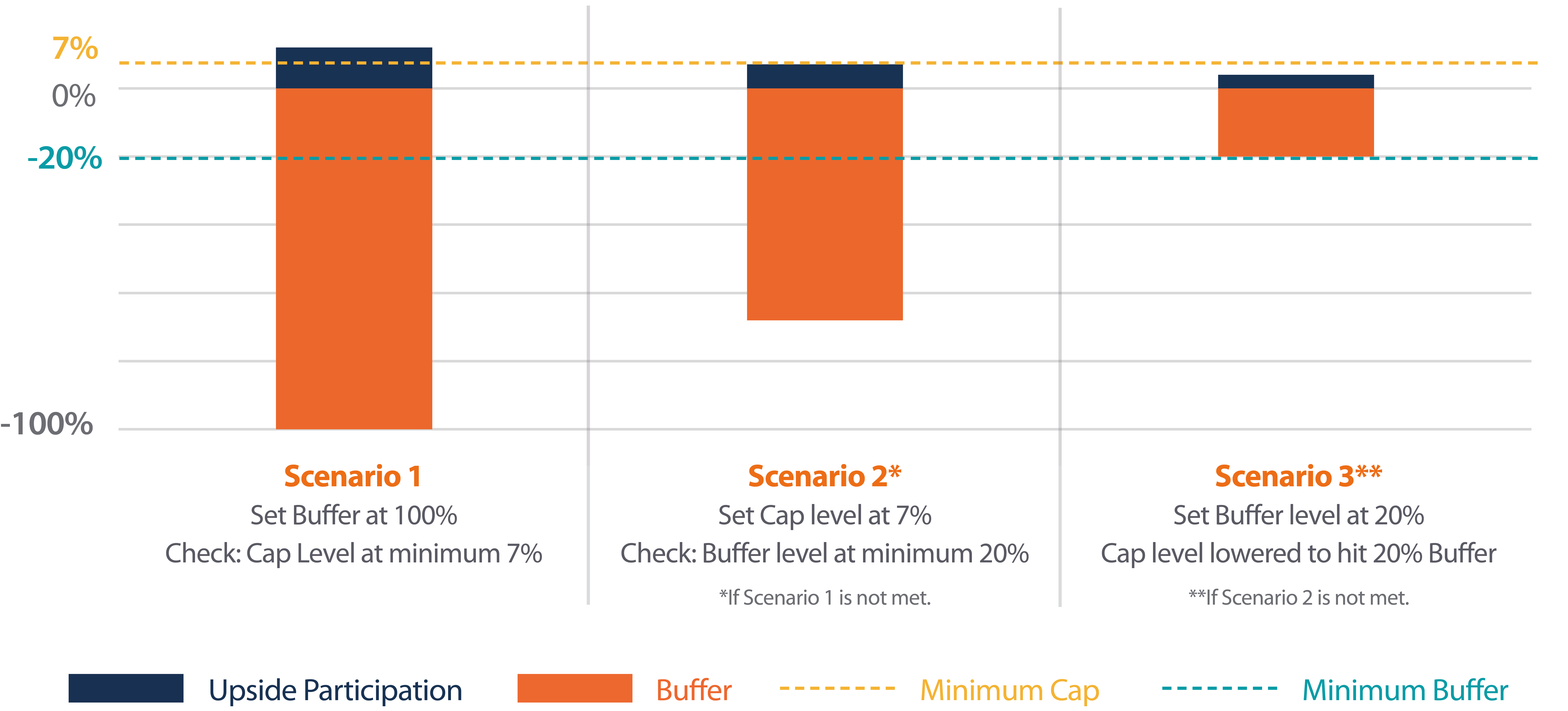
On each reset date the new Buffer Level and matching cap level is being determined following the mechanism described in the scenarios below.
Scenario 1
If the fund can set the buffer against 100% of the underlying ETF losses while setting a cap of at least 7%, it may seek a predetermined cap that exceeds 7% until all net asset value is invested.
Scenario 2
The fund will seek to provide the maximum available buffer against losses (depending on market conditions) while setting a predetermined upside cap of at least 7%.
Scenario 3
If the 7% minimum cap produces a buffer of less than 20%, the fund will seek to lower the minimum cap to provide a buffer of at least 20%.
Portfolio construction
Target Outcome UCITS ETFs are actively managed using a “target outcome strategy” which seeks to produce a predetermined investment outcome based on the performance of the underlying assets, through the use of FLEX Options.
FLEX Options are customised options contracts with the ability to customise terms of an option, including exercise process, underlying reference assets and expiration dates. Unlike OTC contracts, FLEX options are listed publicly and transparently on the exchange in Chicago (“CBOE”). The example below illustrates the expected 1-year return profiles of a fund, before fees and expenses.
1 Year return profile example
Target Outcome UCITS ETFs offer exposure to a reference asset (underlying index) that is based on a market index and has the following components.
10% Buffer
15% Moderate Buffer
Max Buffer
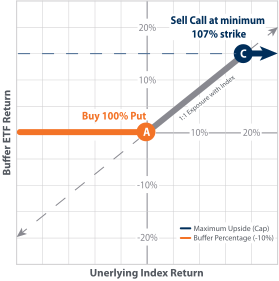
Case 1: 100% Buffer
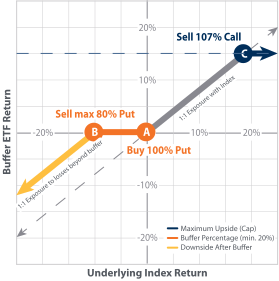
Case 2: \lt 100% Buffer
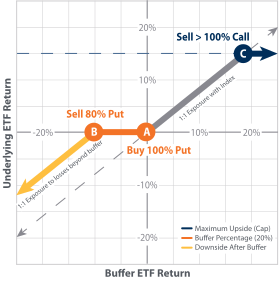
Case 3: \lt 100% Buffer
How do they work?
| Sample Portfolio | Option Position | Type | Purpose | Expiration |
|---|---|---|---|---|
Set Exposure | Purchase | Call | Buying a deep in-the-money call (near 0%) sets the equity exposure. | 12 months expiration dates |
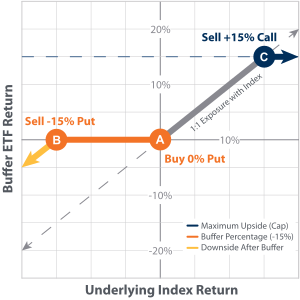
Set Buffer Limit | Purchase (A) | Put | Buying a put sets the downside buffer. | 12 months expiration dates |
Write (B) | Put | Selling a put, where your buffer ends, partially funds the downside buffer. | 12 months expiration dates | |
Set Upside Cap | Write (C) | Call | Selling an out-of-money call funds the downside buffer. | 12 months expiration dates |
Target Outcome Products
Please click here for definitions of the above terms, or contact us.
The Value / Return performance above is based on the start of the relevant target outcome period. Performance is shown in the base currency of the share class which is in USD. Therefore, information provided may not accurately reflect the currency in which investors make an investment into the fund. Returns may increase or decrease as a result of currency and exchange rate fluctuations. Performance can go up as well as down, and investors may lose some or all of their capital. Please refer to the 'Risks' section in the KID/KIID, related supplement, and prospectus, on risks associated with an investment in the fund.
Please Note: The Fund values shown are based on the Fund’s bid/ask midpoint as of the date and time stated.

